

Seeking out the
5000 greatest films
in a century of cinema



Toy Story 5



Produced by Lindsey Collins and Jessica Choi
Editing: Jason Hudak, Jennifer Neysa Jew, Ayse Dedeoglu, and Robert Grahamjones
Music: Randy Newman
Release Date: 17 June 2026
Aspect Ratio: 1.85 : 1
Color: Color
In the late 2010s, when Disney announced it was making a fourth Toy Story movie, everyone from fans of the series to industry insiders to film commentators and podcasters to Quentin Tarantino balked at the idea and viewed it as a blatant and cynical cash grab from a greedy company that was losing its creative and innovative soul. I was among this throng that considered it sacrilege to tack on another chapter to a series that ended so perfectly. Toy Story 3 marked not only that rarest of occurrences in a movie trilogy, in that the last film was the best of the lot; it was one of the most emotionally powerful animated features of all time and one of the decade's best pictures. We knew why the Disney suits wanted a fourth movie, but why would the Pixar braintrust agree to sell themselves out after wrapping up the series so perfectly in 2010?
But Toy Story 4 surprised everyone by not simply being a week retread of its prior installments, but by taking on significantly different themes with a markedly different structure that still felt seamlessly connected to the first three movies. Toy Story 4 largely abandoned its ensemble to concentrate on the central character of Woody (Tom Hanks) as he struggles with an identity crisis. He's feeling obsolete and unneeded by the new kid to whom he and his pals were given at the end of Toy Story 3. He goes on an adventure, reuniting with a long-lost friend, the fiercely independent Bo Peep (Annie Potts), and becoming a kind of mentor to a new, homemade toy named Forky (Tony Hale). Pixar movies are always made as much (if not even more) for parents than kids, but this was literally a movie about what it's like to be a late-middle-aged dad suffering from feelings of obsolescence and needing to go on a journey of self-actualization after reconnecting with the sexy woman that got away. With that as the subtext, Toy Story 4 should have ended up a tonally embarrassing picture that didn't play at all to its intended kiddy demographic, and yet, it was a sublime piece of storytelling that was as much for kids and family as any of the prior pictures. It was kind of miraculous. So why not try again?
Just like its predecessor, Toy Story 5 makes a lot of smart conceptual-level choices. Since Woody was so much at the forefront of Story 4, his role amounts to little more than a glorified cameo in Story 5. He's still off living his late-middle-aged renaissance with Bo Peep and just pops in long enough for this to qualify as a legit Toy Story movie. Director/co-writer Andrew Stanton and the creative team brilliantly depict Woody as now balding by having the paint of the hair under his cowboy hat rub off with age. It's such a memorable detail, and it's placed front and center near the top of the film, that it makes Woody feel like a bigger part of this movie than he is. With the principal character taking a backseat this time out, we might think the series other top-billed co-star, Tim Allen's Buzz Lightyear, would take center stage. But the delusional Buzz, who took the entirety of the first movie to realize he was a toy and not an actual spaceman, is a much more limited character in terms of adding human dimension. Not to mention the fact that Buzz has already been spun off twice with the TV series Lightyear of Star Command: The Adventure Begins in 2000 and Lightyear, the 2022 feature in which Chris Evans voiced the actual Buzz Lightyear on whom the toy is supposedly based.
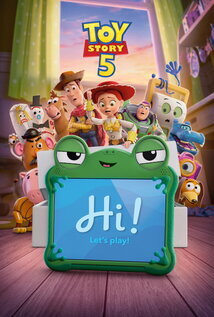
Instead, the focus of this film is on Jessie, Woody's cowgirl counterpart, voiced by Joan Cusack, who was introduced in the first sequel film. This is another strong choice. Since Andy's toys all now belong to a little girl with whom Jessie identifies strongly, she can have the same devotion to her kid as Woody had to his in the previous films. The movie also makes the strong thematic and narrative choice of making the principal villain of the story an internet-connected tablet designed for pre-teen kids named Lilypad, voiced by Greta Lee. Addressing the onset of technology is something the Toy Story films have avoided up until this point, and that was probably a wise decision since these films operate in the grand tradition of movies that use state of the art technology to state anti-technological themes—2001, Star Wars, Jurassic Park, The Matrix, and Pixar's WALL-E to name just a few. And 2026 feels like the right time to take on this issue, because never since the introduction of the internet has there been more skepticism about the cost-benefit ratio of the technologies we've all surrendered ourselves to, especially when it comes to kids and tech. Toy Story 4 was released right around the time a Los Angeles jury found Meta and YouTube liable for negligent design, awarding a young plaintiff $6 million in damages in the first major trial verdict of its kind (currently being appealed by both companies).
Painting the young Bonnie as a potential victim of "tech," and empowering an overenthusiastic Jessie to try to step in as her protector, allows the film to explore in tangible ways how introducing social media into children's lives, especially the lives of pre-adolescent girls, increases social anxiety, and how attempts parents make to limit the influence of tech can backfire and be even more detrimental. But the movie wisely doesn't paint Lilypad as a two-dimensional, purely evil villain (the fatal mistake the screenwriters made with Wayne Knight's toy collector character that doomed Toy Story 2 to the bottom of the heap of these movies). Instead, Lilypad possesses the kind of smug, over-eager, inconsiderate, and underhanded personality we'd want to ascribe to a piece of anthropomorphized toddler tech, yet when she discovers that's she's causing harm to her human charge, she attempts to correct the situation. That may be too benevolent a view of AI, but this movie is naturally going to make the point that we can't put the genie back in the bottle, so we need to be smart about how to keep the tech we've already allowed into our lives from ruining our lives.
So, in the abstract, everything would seem to be there to render Toy Story 5 as surprisingly successful as Toy Story 4 was. But in practice, the magic just isn't there. No matter how well thought out the story's subtext and narrative, and no matter how great it is to see Cusack get to play the lead, the actual adventure Jessie goes on is a retread of the adventures Woody and the others had in the first three movies. There is just not enough that's fresh and engaging about this movie for it not to become sluggish and even tedious well before its midpoint. The filmmakers keep coming up with good ideas, such as the introduction of some long-discarded early attempts at tech-enabled toys who become Jessie's allies. And, while the screenwriters find little to do with Buzz Lightyear beyond having him develop a crush on Jessie without the guts to profess his love, which could easily have reduced the already flat character into a one-note joke, they devise a clever way for Allen to get to voice an entire army of Buzz Lightyears.
Still, unlike the brilliant ways the Pixar filmmakers have been able in past films to take clever narrative concepts, comedic characterizations, and lofty thematic ideals and realize them in fresh, immensely entertaining ways, this story largely feels rote and derivative. Conan O'Brien voicing a toilet-training toy named Smarty Pants illustrates this issue; it's a funny idea, the characterization and dialogue are sharp, and he becomes integral to the story, but he never made me laugh or even crack a smile. I appreciated the way Lilypad was depicted, but I didn't really enjoy looking at her or listening to her anymore than I warmed to the new good guys. Similarly, I admired from an intellectual distance the layered characterization of Jessie and the difficult realizations she undergoes over the course of her adventure, but by the end I just wasn't invested in the outcome. Certainly not to the extent that I loved all the wonderful characters introduced in Story 3 and Story 4 and how surprisingly swept up I was in their plots; thrilled by their climaxes and moved by their emotional conclusions.
I'm giving Toy Story 5 three stars as I think it pretty much delivers what it sets out to deliver, just not in a very satisfying way. It is a prime example of how movies ranked at the top of my two-and-a-half-star list for a given year are often far more interesting and rewatchable than those that reside at the bottom of that year's three-star list. Toy Story 5 is a major box-office success, and critics have been very kind to it. But there is no doubt in my mind that if this exact same film had been released in 2019 as Toy Story 4, those same critics would have had their knives out, and audiences would never have flocked to it repeatedly with the level of enthusiasm they did this year.
The latest in the Toy Story saga feels much more like a derivative and unnecessary sequel than the surprisingly strong predecessor, but its smart conceptual choices and the layered character development of its cowgirl doll heroine make it worth seeing.