

Seeking out the
5000 greatest films
in a century of cinema


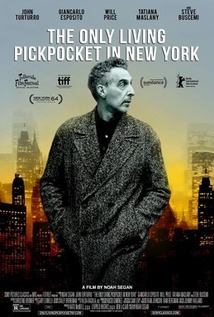

The Only Living Pickpocket in New York



Produced by Ben LeClair, Katie McNeill, and Leopold Hughes
Editing: Hilda Rasula
Music: Gary Lionelli
Release Date: 16 October 2026
Aspect Ratio: 1.85 : 1
Color: Color
Back in the 1990s, a tight, solidly scripted, well-shot 88-minute character study set in New York City about the specific life of a unique, if unremarkable, individual would have gotten three or three and a half stars from me. After all, back then there were many indie films of this ilk that were well worth seeing, if not exactly what one would call a "must-see." In 2026, however, a movie like this feels like a remarkable event. It's a four-star film that I won't be surprised if it makes my top 10 of the year.
Written and directed by Noah Segan, an actor best known for small roles in every Rian Johnson-directed feature, The Only Living Pickpocket in New York stars John Turturro in a wonderful showcase of his talents. Turturro plays Harry Lehman, a man in his late sixties who has made his living as a pickpocket in New York City, though that life has become far more challenging in our largely cashless surveillance society. Also, Harry's wife, Rosie, is profoundly disabled and unable to care for herself. But Harry seems to take this all in stride. Rather than listen to him complain to his contemporaries or watch him suffer through repetitive, mundane tasks, we just witness the unique ways he goes about his daily life and how he's adapted ever so slightly to a world that's changed around him.
Harry's attitude is the most surprising and appealing of the myriad ways in which this movie pays homage to a bygone era and an older way of operating in society. Segan's picture is overly, while never hanfistedly, reverential to the way indie movies used to be back in the last truly golden era of small- to mid-budgeted stories that got made because name actors attached themselves to the project and were almost guaranteed to be bought at Sundance or SXSW by a distributor like Miramax, Fine Line, October, or Sony Pictures Classics (which is the last of these companies still functioning as it once did and also the distributor of this film).
Turturro was one of the great pillars of indie filmmaking after becoming a recognizable character actor in films like Desperately Seeking Susan, Hannah and Her Sisters, and The Color of Money, where his single scenes (and often just single lines!) made him an instant "that guy." In addition to Turturro, Pickpocket also features '80s-'90s indie film icon Steve Buscemi and Turturro's Do the Right Thing co-star Giancarlo Esposito. Each delivers a terrific supporting role. Buscemi plays Ben, the pawn shop proprietor who fences much of the merchandise Harry lifts. Esposito plays Detective Allan Warre, a cop of a similar age who will soon reach mandatory retirement. Thus, Allan and Harry are more like old friends than longtime adversaries. Their scenes reminiscing about the good old days, both verbally and nonverbally, are highlights of a film that isn't subtle about the parallels it draws to how old-school movie stars used to function in the world of independent cinema.
As someone who had an almost Tom-Waite-esque desire to be middle-aged when I was in my late teens and 20s—back during the era of indie cinema this movie wistfully harkens to—I could watch scenes like this for days and never get bored. The way these old dudes move through the world, stay true to their word, and try to live up to a code of honor, even though they're not exactly "great guys," is profoundly comforting to a 55-year-old like me, who often feels stuck between the harsh, everyone-for-themselves, fuck-your-feelings crowd and the delicate, risk-averse souls who need even the most constructive criticism to be sheathed inside a soft bubble of feel-good platitudes, acknowledgments, and positive reinforcement. Remember when people just went on with their lives day after day? This movie does.
Pickpocket does not try to subvert, reinvent, upturn, or reject its narrative formula. On the contrary, Segan's embrace of the Sundancey, Robert McKee, three-act structure is part of what's so heartening. There's a reason so many films follow a tried-and-true "formula." And while it's always a thrill when a filmmaker can subvert genre tropes and structures, the dozens of terrible movies that inevitably follow these once-in-a-blue-moon subversions that try but can't duplicate their originality are insufferable. To create something fresh within a strict formula is the poetry of cinema, and it's nearly always more satisfying than a middling attempt to reinvent the wheel.
The plot concerns Harry unwittingly swiping a USB stick belonging to a member of a New York crime family. When they track him down, they give him a short time to get that USB stick back. Many movies of this ilk are crime stories or involve the mob, and there's a good reason for that. It's shorthand. Screenwriters and directors have a limited amount of time to tell their stories, and when you don't need to spend a lot explaining your antagonist to your audience, it frees you up to spend time observing the distinctive life of your protagonist, which is typically the character that got the filmmaker and the audience excited about the film in the first place.
It's not that this type of picture has totally disappeared from movie screens; it's just that people seem to have forgotten how to make them well. This same year saw the release of Daniel Roher's Tuner, another well-acted, tight little character study set in New York and centered on a distinctive protagonist I've never quite seen at the center of a movie before, who gets involved with criminals. It's a terrific premise with a fantastic first and second act, but, boy, does it fall apart into a mess of contrivance at the end. You'll sprain your back trying to suspend disbelief in that film's third act. This is not the case with Pickpocket, which ends just as it should. No big twist, no last-minute double-cross, just an amusing way for the protagonist to get the last laugh that you can see coming from a mile away, and that's not a flaw. There's real pleasure in watching a fresh spin on a tale so oft-told that you could predict each beat if you wanted to. Because when the characters and actors are as enjoyable as the ones here, inviting you into their fascinating little world for 88 minutes, why the hell would you want to?
Noah Segan's wonderful homage to a bygone era of indie cinema provides a showcase for star John Turturro and a reminder that creating something fresh within a strict formula is the poetry of cinema, and nearly always more satisfying than a middling attempt to reinvent the wheel.