

Seeking out the
5000 greatest films
in a century of cinema


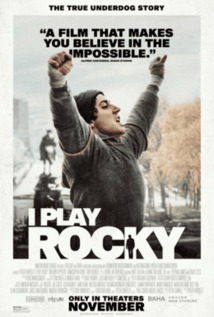

I Play Rocky



Produced by Peter Farrelly, Toby Emmerich, Paul Currie, Christian Baha, and Michele Weiss
Editing: Sam Seig
Music: Dave Palmer
Release Date: 06 November 2026
Aspect Ratio: 2.00 : 1
Color: Color
Going to a sold-out festival screening of this movie made me feel like the only guy with a gluten allergy at a convention of plain donut lovers. I'm not sure what hypnotic quality Peter Farrelly worked into this picture that so many people I view as either curmudgeonly cynical film critics or discriminating film programmers would eat this slop up with such gusto (especially since some of them consider Farrelly's Green Book, a perfectly serviceable if bland and tone-deaf piece of fact-based fluff, a literal crime against humanity). Well, I'm beyond trying to figure out what makes people love certain movies and hate others, but it was fun to see Rocky cosplayers at the screening. I'm glad some people out there revere Rocky with the same kind of fandom I associate with Marvel and Lord of the Rings; I just don't think I'm gonna enjoy a movie made for those folks any more than I enjoy Marvel or Lord of the Rings.
I Play Rocky tells the oft-told, underdog-made-good, true Hollywood story of how the unknown nobody Sylvester Stallone, a struggling actor who looked and sounded like a meathead due to his compact muscular physique and a mild speech impediment caused at birth, wrote a great screenplay for himself and refused to sell the material unless he got to star in the picture. It's one of the rare showbiz parables about believing in yourself and never giving up that's actually true and doesn't need embellishment to be inspirational. This, naturally, does not prevent Farrelly and screenwriter Peter Gamble from embellishing the hell out of this story.
Anyone who reads my reviews will know that I'm not a fan of the biopic genre, but the ones I like the most narrow the scope of their Peter Gamblestory to a defining event in their protagonist's life and take all kinds of liberties with the facts. This is the only way to make a compressed, fictionalized narrative clear and compelling so as to get at something truthful within the confines of a feature-length film. Compressing timelines, inventing composite characters to stand in for several key individuals, moving the chronology of events, etc., can all help streamline a narrative and capture the essence of a true story without getting bogged down, confusing, or tedious because of strict adherence to facts. So it might seem that I Play Rocky would land right in the sweet spot for a biopic I might enjoy.
Unfortunately, I Play Rocky does the opposite of what the best films of its ilk do; the liberties it takes with the facts make its fictionalized story less clear and less compelling. I would go as far as to say it takes an extraordinary showbiz tale and makes it ordinary, even generic. While I could go through the film beat by beat and explain why I think each choice cheapens the more interesting truth by ringing distractingly false notes, I'll single out one example that exemplifies my issue.
Watching this movie, you'd think Rocky was entirely filmed in the city where it takes place, Philadelphia, and that this location was chosen because the powerful and sinister unions in New York would make shooting there too expensive. In one scene, the Rocky company is filming a scene of Stallone's character being interviewed in a meat locker where he pounds sides of beef like a heavy bag. A New York union boss drives down to put a stop to the shooting, and producers Irwin Winkler and Robert Chartoff (P. J. Byrne and Toby Kebbell) stall him by telling him they're just on a location scout, which gives the cast and crew time to successfully hide before the guy checks things out.
As shorthand for how under-the-radar and quasi-guerrilla-style this low-budget studio picture was made, I'd have no issue with this scene IF the Rocky of this movie only shot for five days in Philly, as indeed the actual film did (like most films of its era, Rocky was shot almost entirely in Los Angeles). With just five days of location shooting, we might be able to believe this union boss would pose a threat only that one day and wouldn't follow up, talk to the labor leaders in heavily unionized Philly, or come back for another surprise inspection at any other point in the weeks-long production. But the implication that this entire movie is being shot in Philly makes the union tough-guy look like a fool rather than a threat. This mirrors every potential source of antagonism in this movie—everybody against Stallone is a complete imbecile and therefore very easily thwarted.
Rocky is a small film with big dramatic stakes. It follows a small-time palooka who wants to see if he can go the distance in the ring with the champ. To achieve this goal, the protagonist must overcome his deeply ingrained low self-esteem and shyness, as well as the poverty he comes from, the physical exhaustion of training, and the lack of respect from everyone around him, including the man he asks to be his trainer, Burgess Meredith's Mickey Goldmill. I Play Rocky, on the other hand, is a big, bombastic movie with almost no stakes at all. Its supremely self-confident protagonist seems able to easily overcome every obstacle that comes his way: interpersonal, financial, professional, physical, you name it. This movie's Sly Stallone just kinda moves through whatever is in his way with a shrug and a mumble. If he ever has a moment of self-doubt, he's got a support group led by his adoring, picture-perfect wife, Sasha (AnnaSophia Robb), to fortify his ego with platitudes.
You can't tell an underdog story unless the protagonist is credibly challenged. Yet even the physical difficulties of playing a boxer without ever having boxed before seem easily overcome here, and not with any of the quiet patience of the original Rocky. We think of that series as being dominated by training montages that speed through the difficulty of training with a rockin' '80s anthem underscoring it, but this was more indicative of the many Rocky sequels. Yes, the first Rocky does have a big, inspirational training montage, but that's offset by lots of scenes of Rocky putting himself through the paces in the cold, dark streets of Philly. We feel Rocky Balboa's pain in Rocky. We don't feel Stallone's pain in I Play Rocky, even though the film implies the United Artists studio chief designed the shooting schedule to deliberately injure its lead actor so production would fall behind and they could replace Stallone with a real star.
Tracy Letts plays that arrogant, knuckleheaded studio mogul, Sandy Maddox, who, I guess, is meant to be UA studio chief Arthur Krim. Again, I wouldn't mind the creative license taken that reduces Krim, one of the smartest, most respected, and most gentlemanly movie studio heads in the history of movie studio heads, to a dumbass blowhard because so many movie studio execs were and still are dumbass blowhards, so the sentiment feels truthful. But Maddox is so silly, stupid, and easily duped that he poses no real threat to Stallone's goal of getting to play Rocky.
Then there's Matt Dillon as Stallone's father, whose purpose in the movie is... What is his purpose? I guess he illustrates that Sly had a tough upbringing? (Was it tough, or just what a 1970s upbringing seems like to a contemporary audience?) Frank Stallone Sr. seems to exist only because biopics traditionally have a parental character, and movies need name actors on the poster so they can have those "with/and" credits at the end. Like Letts and Robb, Dillon is a good actor playing a bad trope.
Speaking of good actors, all biopics and biographical docudramas live and die by the strength of their lead performance, and Anthony Ippolito seems to be a shoo-in for an Oscar nomination for playing Stallone. However, for most of this movie, he isn't actually playing Stallone; he's impersonating Rocky. I'm not just talking about when he's playing Stallone playing Rocky; I mean all the time. There are a couple of moments when we see a character that doesn't come off like an SNL impression of Rocky Balboa, and maybe those will be the clips used for the Oscar race. But for the most part, Ippolito is doing an impression rather than inhabiting a role. I randomly watched this year's fictionalized true story about an actor crowd-pleaser on consecutive nights with this year's fictionalized true story about an actor crowd-weeper, Elsinore, and I don't think you could ask for a more crystal-clear example of the difference between doing an impression and creating a character that looks and sounds exactly like the real person the character is based on.
Apparently Stallone had nothing to do with the inception, creation, or execution of this movie. So living in a time when so many of the more acclaimed "documentaries" are little more than feature-length propaganda controlled by their subject or their late subject's family, it's wild to see such a sensationalized, heavily fictionalized fantasy portrait of a real person in a picture that that person didn't participate in at all. But I think all the empty positive reinforcement this movie-Stallone gets is meant to vicariously apply to the viewer rather than kiss the ass of the subject. It makes us feel good for a few fleeting moments the way a participation trophy does. I Play Rocky is a film about filmmaking designed for those nimrods at filmmaker Q & As who invariably ask, "How much of the movie was improvised?" The film would have you believe most everything that made Rocky special was a fluke that happened despite the creative production team that made the movie with Stallone, rather than because of them. It's a 1970s underdog story made for the superhero era, full of straw-man antagonists, offering nothing in the way of true inspiration for how one actually overcomes real-world challenges.
Peter Farrelly and Peter Gamble craft a fantasy 1970s underdog story for the superhero era, full of straw-man antagonists, baffooish collaborators, and empty positivity, offering nothing in the way of real inspiration for how one might actually overcome real-world challenges.