
Seeking out the
5000 greatest films
in a century of cinema


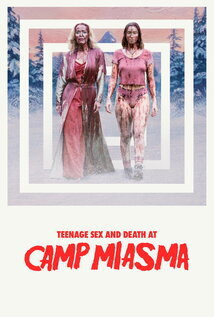
Teenage Sex and Death at Camp Miasma

Produced by Dede Gardner and Jeremy Kleiner
Editing: Graham Mason
Music: Alex G
Release Date: 06 August 2026
Aspect Ratio: 1.85 : 1
Color: Color
Jane Schoenbrun follows up We're All Going to the World's Fair and I Saw the TV Glow with another horror-tinged meta-meditation on how many in their generation and younger derive meaning, purpose, and identity from the media they consume through screens. The whimsically titled Teenage Sex and Death at Camp Miasma is more playful than Schoenbrun's prior outings, and seemingly more mainstream. But those expecting a Millennial/Gen-Z take on a classic slasher movie might be disappointed. This is a far more personal film that, like their prior pictures, centers on two characters.
Hannah Einbinder stars as Kris Williams, a young, Queer filmmaker hired to reboot a horror franchise she grew up loving despite its "problematic" qualities. The opening title sequence shows us that the Camp Miasma series is essentially Friday the 13th, but instead of the knife-wielding, bag-headed or hockey-masked Jason Voorhees, the killer in these slasher films, named "Little Death", is the ghost of a camper who, in life, transformed from a boy to a girl depending on the day of the week, and now haunts the campgrounds, rising from the lake wearing an exhaust vent over his face and slaughtering unsuspecting teenagers with a spear.
Kris is determined to involve the original Camp Miasma's reclusive star, Billy Presley, who retired from acting after playing the final girl in the original movie. Turns out, Billy lives at the deserted camp where the series was filmed, up in the Pacific Northwest. Now in her late fifties, Billy isn't what Kris expects. She's warm and friendly but mysterious. She's perceptive and curious, but also somewhat dismissive of Kris's contemporary-minded, overly analytical take on these slasher movies. Kris and Billy are instantly drawn to each other, but they may also be drawing Little Death to them.
Gillian Anderson plays Billy, and it's an inspired piece of casting. Anderson plays Billy like a cross between Gloria Swanson and Dolly Parton. She and Einbinder have such terrific chemistry. Schoenbrun, cinematographer Eric Yue, and production designers Matt Hyland and Brandon Tonner-Connolly create such an effective, dreamlike reality for the two of them to exist in that anytime the film allows other characters to invade it, the picture diminishes from something special to something generic. I had similar issues with certain choices in I Saw the TV Glow that jolted me out of the spell the film cast and made me appreciate the more consistent We're All Going to the World's Fair.
Similarly, the filmmakers depict the movie's dreamlike present-day with exquisite attention to detail, like the way the forest and lake surrounding the camp are sometimes rendered as stylish matte paintings. But the film's conceptual reality is undercut when we see footage from the fictional Camp Miasma movie, in which Little Death's killings are rendered with CGI and comical blood spattering that can't be squared with the era this movie was supposedly made in. So much of Teenage Sex and Death is about an obsession with certain cinematic aesthetics that, when these are violated, it becomes difficult to maintain our connection to the protagonist. And since much of the film's climax is tied to an event from the original Camp Miasma movie, the final act of Teenage Sex and Death, as visually effective as it is, is narratively unsatisfying.
Schoenbrun continues their horror-tinged meta-meditation on how many in their generation derive meaning, purpose, and identity from the media they consume on screens, through this story about a young queer filmmaker hoping to reboot a dormant slasher franchise by luring back the reclusive star of the original.