

Seeking out the
5000 greatest films
in a century of cinema


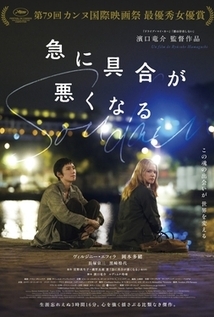

All of a Sudden
Soudain
Kyū ni guai ga waruku naru


Produced by Renan Artukmac, Joseph Rouschop, Bettina Brokemper, David Gauquié, Julien Deris, Kosuke Oshida, Yuji Sadai, Jean-Luc Ormières, Hiroko Matsuda, and Charlotte Dauphin
Editing: Azusa Yamazaki
Music: Samuel Andreyev
Release Date: 19 June 2026
Aspect Ratio: 1.50:1
Color: Color
The latest from Ryusuke Hamaguchi (Wheel of Fortune and Fantasy, Drive My Car, Evil Does Not Exist) is another fascinating and lengthy minimalist meditation on life (and death), seen through the eyes of a small number of characters.
The beguiling Belgian/French actress Virginie Efira (Elle, Sibyl, Benedetta) stars as Marie-Lou Fontaine, the young director of a suburban nursing home near Paris for patients with dementia. Marie-Lou is a proponent and practitioner of a French method of caregiving imported from Japan called "Humanitude," which centers on respecting the integrity of each human being in a facility. Many of the traditional nurses on her staff resist this new-agey approach, especially the senior nurse Sophie (Marie Bunel), who has been employed at the facility since back when it was a mental hospital. Vocally dismissive of the method, she refuses to be trained in the technique and is critical of how spending so much individual time with each patient overworks the staff.
To escape the pressures of the job, Marie-Lou attends a performance of a play put on by two Japanese theater practitioners she has a chance encounter with. Tao Okamoto plays Mari Morisaki, the play's director, and Kyōzō Nagatsuka is Gorô Kiyomiya, the star. In their one-man show, Gorō portrays the Italian psychiatrist Franco Basaglia, the man responsible for abolishing mental hospitals in Italy. Marie-Lou is quite taken with the performance, including the way the show continues when Gorô's developmentally disabled grandson runs on stage. Marie-Lou and Mari become friends, and we learn that the playwright has a terminal illness that will soon take her life.
All of a Sudden is based on the nonfiction book, When Life Suddenly Takes a Turn: Twenty Letters Between a Philosopher with Terminal Cancer and Medical Anthropologist, which is a collection of letters exchanged between philosopher Makiko Miyano and medical anthropologist Maho Isono over a period of time when Miyano was fighting the metastatic breast cancer that eventually took her life. Hamaguchi and co-screenwriter Léa Le Dimna transpose the book's setting to France, creating a fascinating cinematic cultural exchange in which both main characters (and actors) are bilingual and converse freely back and forth in both French and Japanese.
While the film shares certain touchstones with the filmmaker's Oscar-, Cannes-, and Japan Academy Film Prize-winning Drive My Car, namely the use of live theater to illuminate certain feelings and intellectual concepts that aren't typically available in cinema, this is a very different picture than anything I've seen from this director before. For one thing, it's verbose. The two protagonists spend a great deal of time talking, and it's extremely enjoyable to just sit and listen to two intelligent women talk calmly and rationally about such a wide range of subjects. I found listening to and watching these characters converse to be the most satisfyingly cinematic experience of the year.
I saw All of a Sudden at a sold-out festival screening; arriving late, I was squished between two patrons of the same oversized proportions as myself. As the lights went down, I worried about being trapped in an uncomfortable position for a three-hour-and-seventeen-minute foreign-language picture. My concern was unwarranted. The time flew by as each scene revealed insight after insight. Even more interesting to me is how engaged someone like me, who spends zero time dwelling on the emotional, spiritual, or intellectual aspects of mortality, became with the themes this picture explores. There are several times when All of a Sudden seemed like it was going to take a turn into territory I just wasn't going to be able to hang with. When one character gives a twenty-minute lecture about capitalism, I was sure the spell the movie had cast on me would break. I mean, do two people who can verbally communicate like these two can suddenly pull out a whiteboard and draw diagrams to explain their points in the middle of a conversation? I guess in this case they do. I believed so deeply in their bond by this point that the scene came across as authentic.
As the film, the friendship, and Mari's illness progress, the two friends push the industrialized caretaking system to its limits, and a number of tense moments make us fear everything will come crashing down on them at any second. Hamaguchi lingers on so many things most filmmakers would move on from, and this deliberate pace engenders a patience many of us might never achieve, especially in a setting such as the one where this movie ends up. All of a Sudden is full of rich and rewarding moments and conversations that I won't soon forget. The best movies are about people connecting, and I've not seen a better screen depiction of human connection for many, many years.
Virginie Efira and Tao Okamoto transfix as a nursing home director trying to practice a humane caregiving technique and a theater director living with a terminal illness in Ryusuke Hamaguchi's fascinating meditation on life, death, and human connection.